



Search
Related News
- 00
0000-00
Thermal Sludge Treatment Options: Drying, Pyrolysis, and Incineration Compared - 00
0000-00
Environmental Engineering for ZLD Projects: Site Data, Permits, and Design Risks - 00
0000-00
Zero Waste Water vs ZLD: Process Choices for Industrial Effluent Reuse - 00
0000-00
Sustainable Waste Management Strategies for Plants With Mixed Waste Streams - 00
0000-00
High Temperature Incineration: Temperature, Residence Time, and Emission Limits
Why Thermodynamic Degradation Matters in Dioxin Control




Thermodynamic Degradation is a critical lens for understanding how modern waste-to-energy incineration systems suppress dioxin formation while meeting tightening ESG and emission-control mandates.
It connects furnace temperature, residence time, turbulence, oxygen availability, and rapid flue gas cooling into one compliance-relevant framework.
By improving degradation efficiency, hazardous waste treatment becomes safer, more measurable, and more compatible with energy recovery infrastructure.
Why Thermodynamic Degradation Matters in Dioxin Control
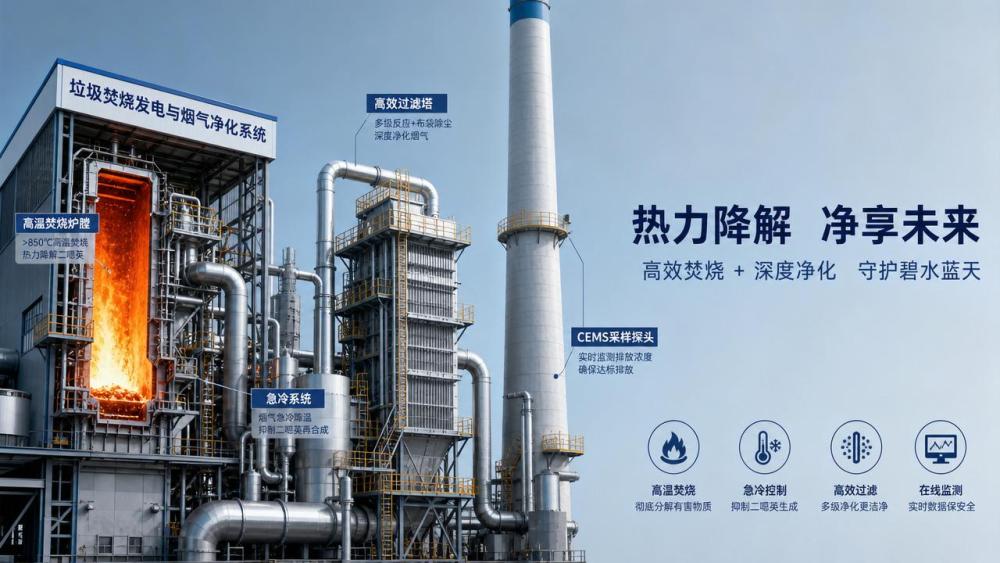
Dioxins are not controlled by a single device. They are controlled by a chain of thermal, chemical, and operational decisions.
Thermodynamic Degradation helps define whether hazardous organic molecules are actually destroyed, or merely shifted downstream into flue gas treatment.
In waste-to-energy plants, this distinction directly affects emission stability, public trust, carbon reporting, and ESG compliance credibility.
The concept is especially important where municipal waste, medical waste, sludge, and industrial residues enter the same thermal treatment ecosystem.
EWRS views Thermodynamic Degradation as part of a wider purification logic linking incineration, CEMS data, energy recovery, and environmental accountability.
Why Checklist-Based Control Is Necessary
Dioxin prevention requires discipline because formation pathways are sensitive to small deviations in temperature, oxygen, metals, and cooling history.
A checklist turns Thermodynamic Degradation from a theoretical principle into a repeatable operating standard for incineration and flue gas systems.
It also supports evidence-based communication with regulators, insurers, lenders, and ESG verification teams reviewing environmental performance.
Without structured checks, even advanced combustion lines can suffer unstable burnout, poor mixing, or secondary synthesis in cooling zones.
Core Thermodynamic Degradation Checklist
- Verify furnace temperature stays above the validated destruction threshold, especially during startup, shutdown, low-load operation, and sudden waste composition changes.
- Confirm residence time in the high-temperature zone is sufficient for Thermodynamic Degradation of chlorinated organics and complex hazardous compounds.
- Maintain strong turbulence so waste particles, volatile gases, oxygen, and heat interact uniformly before entering secondary combustion and boiler sections.
- Control oxygen availability carefully, avoiding both oxygen starvation and excessive dilution that lowers combustion temperature and weakens degradation efficiency.
- Track carbon monoxide, total organic carbon, and furnace pressure trends as early warning indicators of incomplete Thermodynamic Degradation.
- Apply rapid flue gas cooling through the dioxin reformation window to reduce de novo synthesis on fly ash surfaces.
- Stabilize waste feeding rates, calorific value blending, and moisture levels to prevent thermal shocks that disturb combustion chemistry.
- Inspect refractory condition, grate performance, burner response, and air distribution because mechanical faults quickly affect Thermodynamic Degradation.
- Integrate CEMS signals with process data to connect emission excursions with root causes inside the combustion and cooling sequence.
- Document deviations, corrective actions, and retesting results so Thermodynamic Degradation performance becomes auditable rather than assumed.
Key Parameters Behind Reliable Dioxin Suppression
Temperature
Temperature is the primary driver of Thermodynamic Degradation, but average furnace temperature is not enough.
Operators need confidence that cold pockets, wet feed surges, and poor flame coverage are not protecting harmful compounds.
Residence Time
Residence time determines whether high temperature has enough contact duration to complete molecular breakdown.
Short-circuiting gas flows can make a furnace appear compliant while weakening actual Thermodynamic Degradation performance.
Turbulence and Mixing
Turbulence distributes oxygen and heat across the combustion chamber, reducing zones where soot, precursors, or chlorinated fragments survive.
Air staging, burner placement, grate movement, and secondary air jets must be tuned as one combustion system.
Cooling Rate
Even strong Thermodynamic Degradation can be undermined when flue gas cools slowly through the dioxin reformation temperature range.
Rapid quenching, boiler design, and fly ash management therefore matter as much as the furnace itself.
Application Scenario: Municipal Waste-to-Energy Plants
Municipal waste varies daily in moisture, plastics, chlorine content, food residues, and inert materials.
This variability makes Thermodynamic Degradation a moving target rather than a fixed design assumption.
Stable feeding, waste pit homogenization, grate control, and combustion air balancing are essential for dioxin prevention.
When paired with energy recovery, a well-controlled plant can reduce landfill dependence while producing useful electricity or steam.
Application Scenario: Medical and Hazardous Waste Incineration
Medical and hazardous wastes may contain PVC, solvents, pharmaceuticals, metals, contaminated textiles, and high-risk biological residues.
Here, Thermodynamic Degradation must be validated with stricter operating envelopes and more conservative emergency response rules.
Batch changes, packaging materials, and liquid waste injection can quickly alter flame stability and combustion chemistry.
Continuous monitoring and periodic stack testing should be interpreted together, not treated as separate compliance rituals.
Application Scenario: Sludge Co-Incineration
Sludge introduces moisture, ash, sulfur, nitrogen, salts, and trace metals into the combustion environment.
Poor dewatering or unstable drying can depress furnace temperature and reduce Thermodynamic Degradation margins.
Filter presses, heat pump dryers, and blending protocols therefore influence air pollution control performance indirectly.
The best approach treats sludge preparation, combustion, ash handling, and CEMS review as one integrated system.
Commonly Overlooked Risks
Relying Only on Stack Endpoints
Stack results matter, but they usually arrive after the process condition has already changed.
Thermodynamic Degradation should be managed through live combustion indicators, not only periodic laboratory reports.
Ignoring Startup and Shutdown
Startup and shutdown phases often create lower temperatures, unstable oxygen levels, and incomplete burnout.
Dedicated procedures are required before waste feeding begins and before auxiliary burners are reduced.
Underestimating Fly Ash Chemistry
Fly ash can carry catalytic metals and carbon surfaces that promote dioxin reformation.
Thermodynamic Degradation in the furnace must be protected by fast cooling and disciplined ash removal.
Separating ESG Claims from Process Evidence
Energy recovery does not automatically prove clean performance or low environmental risk.
Credible ESG reporting should link Thermodynamic Degradation conditions, emission records, maintenance logs, and corrective actions.
Practical Execution Recommendations
- Build a daily combustion dashboard combining furnace temperature, oxygen, CO, pressure, feed rate, auxiliary fuel, and flue gas cooling data.
- Set alarm thresholds based on degradation risk, not only legal emission limits, so corrective actions begin before stack excursions.
- Calibrate sensors regularly and compare CEMS readings with laboratory checks to avoid false confidence in Thermodynamic Degradation stability.
- Create waste acceptance rules that flag high-chlorine loads, wet sludge, solvent spikes, and materials likely to disturb combustion balance.
- Review every abnormal event within twenty-four hours, then assign mechanical, operational, or feedstock-related corrective measures.
- Train operating teams with incident scenarios covering burner failure, grate jamming, oxygen drop, quench malfunction, and sudden waste variation.
How CEMS Strengthens Thermodynamic Degradation Governance
Continuous Emission Monitoring Systems act as the operating memory of an incineration facility.
They do not replace Thermodynamic Degradation control, but they reveal whether combustion strategy remains stable over time.
When linked to process historians, CEMS data can identify hidden patterns behind CO spikes, NOx shifts, or particulate changes.
This evidence supports regulatory transparency and helps align waste-to-energy assets with carbon and pollution disclosure obligations.
Decision Criteria for Technology Upgrades
Upgrade decisions should not focus only on equipment price or nominal treatment capacity.
The better question is whether the upgrade strengthens Thermodynamic Degradation reliability under real waste variability.
- Prioritize secondary combustion improvements when residence time, oxygen distribution, or flame coverage cannot meet validated performance margins.
- Select boiler and quench designs that minimize slow cooling across temperature bands associated with dioxin reformation.
- Improve waste preprocessing when moisture, particle size, or calorific instability repeatedly causes incomplete Thermodynamic Degradation.
- Strengthen activated carbon, baghouse, and ash systems as safeguards, while keeping destruction performance centered in combustion control.
Summary and Action Guide
Thermodynamic Degradation matters because dioxin control begins before flue gas reaches filters, scrubbers, or monitoring instruments.
It depends on high temperature, adequate residence time, strong turbulence, oxygen discipline, rapid cooling, and verified operating evidence.
The next step is to audit the full incineration sequence from waste acceptance to stack reporting.
Map each control point, assign measurable limits, and connect every deviation to a documented corrective action.
For environmental infrastructure aligned with EWRS principles, Thermodynamic Degradation is not a narrow combustion term.
It is a practical foundation for safer waste-to-energy systems, stronger ESG disclosure, and more defensible dioxin control.
Recommended News
 Thermal Sludge Treatment Options: Drying, Pyrolysis, and Incineration ComparedJun 03, 2026Thermal Sludge Treatment compared: discover how drying, pyrolysis, and incineration impact cost, emissions, energy recovery, and smarter sludge decisions.
 Environmental Engineering for ZLD Projects: Site Data, Permits, and Design RisksJun 03, 2026Environmental Engineering for ZLD projects: learn how site data, permits, brine chemistry, and design risks shape compliant, reliable, cost-effective water recovery.
 Zero Waste Water vs ZLD: Process Choices for Industrial Effluent ReuseJun 03, 2026Zero Waste Water or ZLD? Compare process routes, energy, brine handling, compliance risks, and reuse strategies to choose the right industrial effluent solution.
 Sustainable Waste Management Strategies for Plants With Mixed Waste StreamsJun 03, 2026Sustainable Waste Management strategies for mixed waste plants—cut disposal risk, improve ESG readiness, recover resources, and build a smarter circular operating model.