



Search
Related News
- 00
0000-00
Thermal Sludge Treatment Options: Drying, Pyrolysis, and Incineration Compared - 00
0000-00
Environmental Engineering for ZLD Projects: Site Data, Permits, and Design Risks - 00
0000-00
Zero Waste Water vs ZLD: Process Choices for Industrial Effluent Reuse - 00
0000-00
Sustainable Waste Management Strategies for Plants With Mixed Waste Streams - 00
0000-00
High Temperature Incineration: Temperature, Residence Time, and Emission Limits
When Thermal Desalination Plants Beat SWRO on Reliability




For technical evaluators comparing desalination assets, reliability is not just a performance metric. It defines secure water supply under real operating stress.
While SWRO often leads on energy efficiency, Thermal Desalination Plants can outperform membranes in harsh seawater, high salinity, unstable pretreatment, and mission-critical facilities.
When Thermal Desalination Plants Become the Safer Reliability Choice
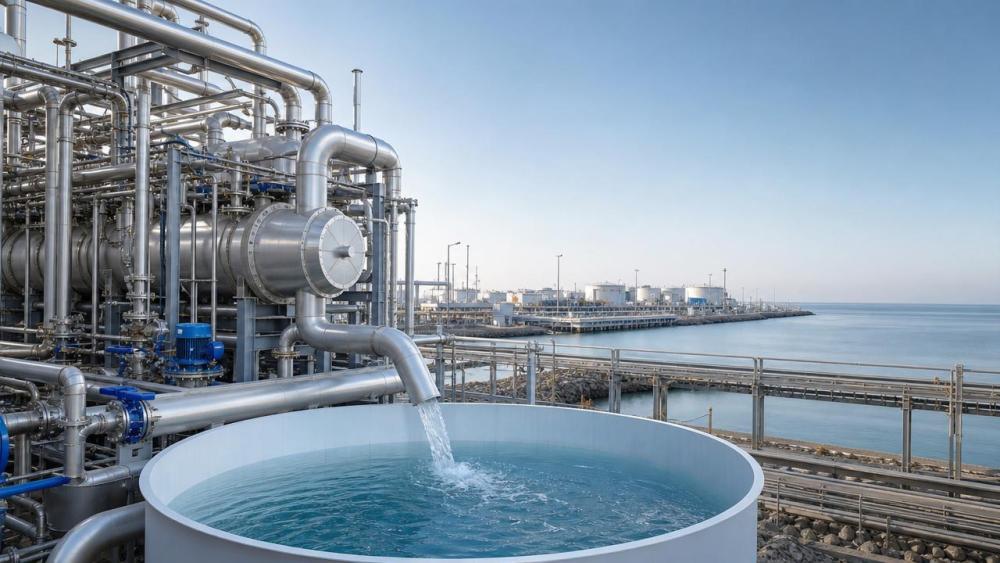
Reliability in desalination is rarely decided by nameplate capacity. It is decided by feedwater volatility, maintainability, redundancy, scaling control, and restart behavior.
Thermal Desalination Plants, including MED and MSF, use phase change rather than membrane separation. That difference matters in difficult coastal environments.
SWRO depends on membrane integrity, pretreatment stability, chemical dosing, cartridge filtration, high-pressure pumps, and frequent monitoring of fouling indicators.
Thermal Desalination Plants are not immune to problems. However, they often degrade more gradually and remain operable during feedwater disturbances.
This makes them attractive where unplanned shutdowns carry greater cost than higher thermal energy consumption.
Scenario Background: Why Reliability Priorities Differ by Site
A desalination plant serving a resort island has different risk tolerance from one supporting a refinery, military base, or municipal emergency reserve.
In power-water complexes, waste steam may already exist. In remote islands, spare membranes and specialized service teams may arrive slowly.
In red-tide zones, intake quality can change within hours. Pretreatment units may become the true bottleneck, not the desalination block.
Therefore, the question is not whether SWRO or thermal technology is universally superior.
The better question is where Thermal Desalination Plants provide stronger availability under local operating constraints.
Scenario 1: High-Salinity Intakes and Extreme Brine Conditions
High-salinity intake water increases osmotic pressure and makes SWRO operation more demanding. Recovery becomes harder, and energy penalties rise quickly.
Membranes also face stronger scaling pressure when calcium, sulfate, silica, or carbonate saturation approaches operational limits.
Thermal Desalination Plants can tolerate higher salinity because evaporation is less constrained by membrane osmotic pressure.
They still need antiscalants, blowdown control, and temperature management. Yet their core separation mechanism remains robust at elevated brine concentration.
For hypersaline gulfs, closed bays, or industrial intake zones, MED or MSF may deliver more predictable water output.
Scenario 2: Unstable Pretreatment and Algal Bloom Exposure
SWRO reliability is highly sensitive to pretreatment performance. A sudden algae event can increase SDI, organic loading, and biofouling risk.
When pretreatment fails, membrane cleaning frequency rises. Differential pressure increases, permeate quality drops, and production may be curtailed.
Thermal Desalination Plants generally tolerate suspended and biological variability better, especially when intake screening and basic clarification remain functional.
This advantage is strongest where red tides, jellyfish ingress, seasonal turbidity, or industrial discharge pulses are common.
For such sites, thermal desalination reliability should be evaluated alongside pretreatment risk, not only energy cost.
Scenario 3: Power-Water Cogeneration Facilities
Thermal desalination becomes more compelling when low-grade steam, waste heat, or power-plant integration is available.
In cogeneration layouts, Thermal Desalination Plants can convert existing thermal energy into dependable water production.
This reduces the apparent energy disadvantage when compared with standalone SWRO.
MSF has historically served large power-water complexes because it is mechanically robust and tolerant of operating variation.
MED can offer better thermal efficiency and modularity, especially when paired with waste heat recovery systems.
The decisive factor is steam availability profile. Intermittent heat may favor hybrid systems rather than pure thermal design.
Scenario 4: Remote Islands and Critical Infrastructure
Remote facilities value operational simplicity, spare-part resilience, and tolerance of delayed maintenance.
SWRO can be excellent when skilled operators, membranes, chemicals, and high-pressure pump service are reliably available.
However, logistics interruptions can turn a small membrane issue into a prolonged water security problem.
Thermal Desalination Plants may be preferred where uptime, repairability, and predictable degradation outweigh lower power consumption.
Hospitals, defense sites, LNG terminals, mining camps, and emergency reserves often apply this reliability-first logic.
Scenario 5: Industrial Sites Requiring Stable Product Water Quality
Industrial users may need stable water quality for boilers, cooling systems, hydrogen production, or ultrapure water polishing.
SWRO permeate quality can fluctuate with membrane age, feed salinity, temperature, and recovery ratio.
Thermal distillate is typically low in dissolved solids and offers a stable base for downstream polishing.
For refineries, petrochemical complexes, and power plants, Thermal Desalination Plants can reduce risk in boiler makeup preparation.
The value is not only water production. It is fewer quality excursions affecting connected industrial assets.
Different Reliability Demands Across Desalination Scenarios
How to Compare Thermal and SWRO Reliability Fairly
A fair comparison must use availability modeling, not only energy consumption. Energy efficiency is important, but uptime determines delivered water value.
The evaluation should include forced outages, planned maintenance, chemical cleaning, seasonal derating, spare-part lead time, and operator skill requirements.
It should also examine how each system fails. Sudden membrane fouling and gradual heat-transfer loss create different operational risks.
Thermal Desalination Plants may continue producing water at reduced efficiency, while SWRO trains may require shutdown for cleaning or membrane replacement.
That difference can be decisive where storage volume is limited or demand is continuous.
Practical reliability metrics to request
- Annual plant availability under worst-season feedwater conditions.
- Mean time between forced shutdowns for each major subsystem.
- Cleaning frequency, duration, and chemical dependency.
- Derating behavior during temperature, salinity, and turbidity peaks.
- Critical spare inventory and realistic procurement lead time.
- Water quality stability during transient operation.
Scenario Fit Recommendations for Thermal Desalination Plants
The best technology decision often becomes a portfolio decision. Many resilient plants combine SWRO, MED, storage, and emergency supply logic.
However, Thermal Desalination Plants deserve priority review when several reliability stressors appear together.
- Select MED when low-grade heat is available and modular reliability is important.
- Consider MSF for very large, rugged power-water complexes with established operating teams.
- Use hybrid SWRO-thermal layouts where energy cost and security risk must both be balanced.
- Increase thermal redundancy for sites with seasonal algae or limited storage.
- Model brine temperature and scaling chemistry before final process selection.
A reliability-first design should not treat pretreatment as an accessory. It should treat intake quality as the first design boundary.
Common Misjudgments That Distort Technology Selection
The first misjudgment is comparing only kilowatt-hours per cubic meter. This hides outage costs, emergency water trucking, and production losses.
The second is assuming seawater quality is stable. Coastal water chemistry can change daily, seasonally, and after storms.
The third is underestimating maintenance logistics. A membrane plant can be efficient yet vulnerable without fast service access.
The fourth is ignoring heat integration. Thermal Desalination Plants can become economically stronger when waste heat is already paid for.
The fifth is using average water demand rather than peak critical demand. Reliability planning must protect the worst week, not the average month.
EWRS View: Reliability Is an ESG and Resource Security Issue
At EWRS, desalination reliability is assessed as part of broader environmental infrastructure resilience.
Water security affects industrial continuity, social stability, carbon performance, and circular economy planning.
Thermal Desalination Plants belong in that discussion because dependable water supply can prevent costly emergency responses.
Their value is strongest where harsh seawater, limited maintenance access, and critical demand converge.
This does not dismiss SWRO. It clarifies where thermal desalination can be the more reliable engineering answer.
Action Guide: Next Steps Before Choosing SWRO or Thermal
Begin with site-specific feedwater history. Include salinity peaks, turbidity events, algae records, temperature profiles, and industrial contamination risks.
Then prepare a reliability model comparing SWRO, MED, MSF, and hybrid configurations under worst-case seasons.
Add lifecycle maintenance assumptions, spare strategies, chemical logistics, operator availability, and emergency water cost.
Where uptime has strategic value, include Thermal Desalination Plants as a serious baseline, not a legacy option.
The best decision is the one that delivers water when the sea, the grid, and the supply chain are least cooperative.
Recommended News
 Thermal Sludge Treatment Options: Drying, Pyrolysis, and Incineration ComparedJun 03, 2026Thermal Sludge Treatment compared: discover how drying, pyrolysis, and incineration impact cost, emissions, energy recovery, and smarter sludge decisions.
 Environmental Engineering for ZLD Projects: Site Data, Permits, and Design RisksJun 03, 2026Environmental Engineering for ZLD projects: learn how site data, permits, brine chemistry, and design risks shape compliant, reliable, cost-effective water recovery.
 Zero Waste Water vs ZLD: Process Choices for Industrial Effluent ReuseJun 03, 2026Zero Waste Water or ZLD? Compare process routes, energy, brine handling, compliance risks, and reuse strategies to choose the right industrial effluent solution.
 Sustainable Waste Management Strategies for Plants With Mixed Waste StreamsJun 03, 2026Sustainable Waste Management strategies for mixed waste plants—cut disposal risk, improve ESG readiness, recover resources, and build a smarter circular operating model.