



Search
Related News
- 00
0000-00
Thermal Sludge Treatment Options: Drying, Pyrolysis, and Incineration Compared - 00
0000-00
Environmental Engineering for ZLD Projects: Site Data, Permits, and Design Risks - 00
0000-00
Zero Waste Water vs ZLD: Process Choices for Industrial Effluent Reuse - 00
0000-00
Sustainable Waste Management Strategies for Plants With Mixed Waste Streams - 00
0000-00
High Temperature Incineration: Temperature, Residence Time, and Emission Limits
What limits industrial desalination plant efficiency most?




Industrial Desalination efficiency is rarely limited by one machine alone. In real plants, the main constraint shifts with feedwater quality, energy pricing, pretreatment stability, membrane condition, and brine discharge limits.
That is why Industrial Desalination performance must be judged by scenario, not by nameplate recovery or pump power alone. The true bottleneck often appears where process design meets regulation, corrosion risk, and operating variability.
For integrated water intelligence platforms such as EWRS, this question matters because desalination now sits inside broader ESG, energy, and resource recovery strategies. Better diagnosis improves uptime, water security, lifecycle cost, and compliance confidence.
When Industrial Desalination efficiency looks strong on paper but weak in operation
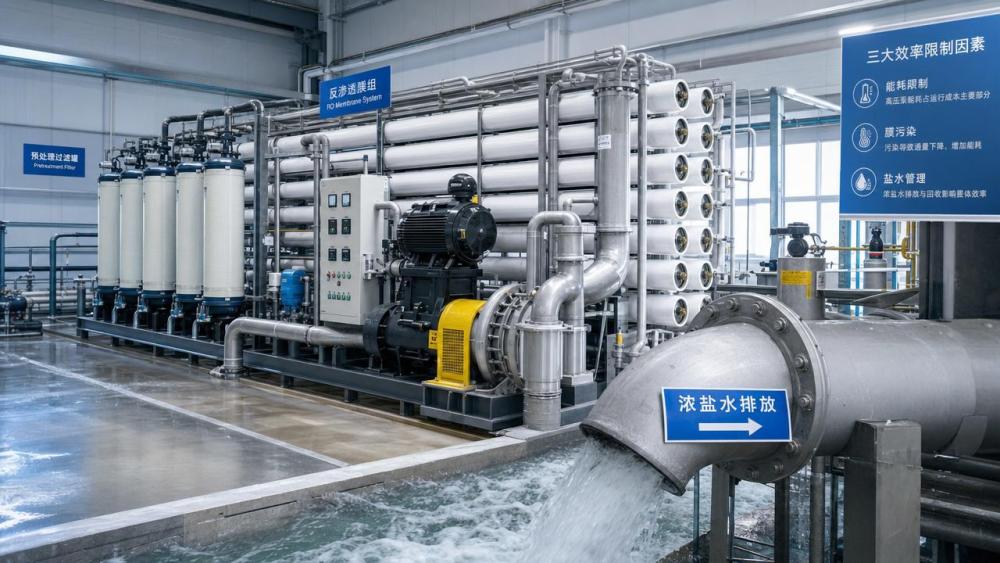
Industrial Desalination systems often achieve excellent test results during commissioning. Later, actual efficiency declines because design assumptions fail under seasonal intake changes, biological growth, or unstable upstream treatment performance.
In seawater reverse osmosis, operators usually focus first on specific energy consumption. Yet lower energy use can be offset by faster fouling, more cleaning events, and reduced membrane life.
In thermal or hybrid systems, the limiting factor may be heat availability, scaling tendency, or materials durability. Therefore, the question is not only what limits efficiency most, but under which operating context.
Scenario judgment: the main bottleneck changes with plant conditions
Industrial Desalination plants serve very different environments. A desert mega-plant, a refinery utility block, and an island water hub do not lose efficiency for the same reasons.
Scenario 1: High-salinity seawater with stable intake
Here, energy demand usually dominates. High-pressure pumping and osmotic pressure set a hard thermodynamic floor. Even efficient energy recovery devices cannot fully eliminate this burden.
However, energy is not the only issue. Small rises in membrane fouling increase differential pressure, reduce permeate flow, and force higher operating pressure, which compounds energy loss.
Scenario 2: Variable coastal feedwater with algae and organics
In this case, pretreatment and fouling control usually limit Industrial Desalination efficiency more than pump performance. Algal blooms, suspended solids, and dissolved organics destabilize membranes quickly.
The hidden cost appears in downtime, chemical cleaning frequency, cartridge replacement, and flux decline. A plant may consume reasonable energy while still performing poorly at system level.
Scenario 3: Inland industrial reuse with strict brine restrictions
For inland sites, brine management often becomes the biggest efficiency limiter. Water recovery cannot be pushed higher if concentrate disposal is expensive, regulated, or physically unavailable.
This is where Industrial Desalination intersects with ZLD. Once RO concentrate enters evaporation or crystallization, energy demand rises sharply, and total water cost can increase dramatically.
Scenario 4: Energy-constrained plants linked to unstable power supply
Where electricity pricing fluctuates or renewable integration is uneven, efficiency is limited by operational flexibility. Frequent ramping can stress membranes, pumps, and pretreatment chemistry control loops.
Under these conditions, a theoretically efficient design may underperform because stable operating windows are too narrow. Digital controls and storage strategies become critical efficiency enablers.
Typical limiting factors ranked by real operational impact
Across most Industrial Desalination projects, four constraints repeatedly dominate. Their ranking changes by scenario, but their interaction explains most underperformance events.
- Energy demand and pressure requirements
- Membrane fouling, scaling, and biofouling
- Feedwater variability and pretreatment mismatch
- Brine disposal, concentration, and regulatory limits
Among these, membrane fouling is often the most operationally disruptive. It does not always create the highest immediate energy penalty, but it quietly damages recovery, reliability, and maintenance economics.
Energy demand remains the most fundamental physical limit. Still, many plants can manage energy better than they manage feed instability, organic loading, or concentrate handling.
How different Industrial Desalination scenarios change the limiting factor
Practical adaptation strategies for each limiting scenario
The best Industrial Desalination improvement plan starts by confirming which constraint causes the largest total performance loss, not just the largest visible energy line item.
- If energy dominates, review recovery ratio, pump efficiency, pressure exchanger performance, and staging design.
- If fouling dominates, strengthen intake screening, coagulation control, UF performance, and membrane cleaning discipline.
- If feedwater swings dominate, install tighter online analytics and use adaptive operating envelopes.
- If brine dominates, compare disposal, concentration, mineral recovery, and ZLD economics before raising recovery targets.
For complex sites, hybrid optimization works best. Industrial Desalination rarely improves through a single retrofit when losses come from linked mechanical, chemical, and regulatory causes.
Common misjudgments that hide the real Industrial Desalination bottleneck
A common mistake is treating membrane replacement as the first answer. New membranes may temporarily restore output, but weak pretreatment soon recreates the same efficiency loss.
Another misjudgment is chasing maximum recovery at all times. Higher recovery can increase scaling, brine stress, cleaning frequency, and downstream concentrate treatment costs.
Some projects also underestimate corrosion and materials degradation. Even when separation performance looks acceptable, reliability losses can reduce effective annual efficiency significantly.
Finally, many assessments ignore system boundaries. Industrial Desalination should be evaluated from intake to discharge, including pretreatment chemicals, cleaning downtime, and concentrate handling energy.
What to evaluate next for better Industrial Desalination performance
Start with a site-specific bottleneck map. Compare energy intensity, normalized flux decline, cleaning intervals, pretreatment upset frequency, and brine disposal constraints over time.
Then test improvement options by total lifecycle impact. A solution that saves power but shortens membrane life may reduce apparent efficiency while worsening long-term economics.
For organizations tracking ESG exposure, connect Industrial Desalination data with carbon intensity, water recovery, chemical use, and discharge compliance. This wider view reveals where efficiency upgrades deliver strategic value.
In most cases, the biggest limit is the interaction between energy, fouling, variability, and brine. The right next step is a structured diagnostic, not a single-component replacement.
EWRS-style intelligence can support that process by linking membrane science, thermodynamic recovery, desalination economics, and compliance trends into one decision framework for resilient Industrial Desalination planning.
Recommended News
 Thermal Sludge Treatment Options: Drying, Pyrolysis, and Incineration ComparedJun 03, 2026Thermal Sludge Treatment compared: discover how drying, pyrolysis, and incineration impact cost, emissions, energy recovery, and smarter sludge decisions.
 Environmental Engineering for ZLD Projects: Site Data, Permits, and Design RisksJun 03, 2026Environmental Engineering for ZLD projects: learn how site data, permits, brine chemistry, and design risks shape compliant, reliable, cost-effective water recovery.
 Zero Waste Water vs ZLD: Process Choices for Industrial Effluent ReuseJun 03, 2026Zero Waste Water or ZLD? Compare process routes, energy, brine handling, compliance risks, and reuse strategies to choose the right industrial effluent solution.
 Sustainable Waste Management Strategies for Plants With Mixed Waste StreamsJun 03, 2026Sustainable Waste Management strategies for mixed waste plants—cut disposal risk, improve ESG readiness, recover resources, and build a smarter circular operating model.