



Search
Related News
- 00
0000-00
Thermal Sludge Treatment Options: Drying, Pyrolysis, and Incineration Compared - 00
0000-00
Environmental Engineering for ZLD Projects: Site Data, Permits, and Design Risks - 00
0000-00
Zero Waste Water vs ZLD: Process Choices for Industrial Effluent Reuse - 00
0000-00
Sustainable Waste Management Strategies for Plants With Mixed Waste Streams - 00
0000-00
High Temperature Incineration: Temperature, Residence Time, and Emission Limits
Tags
When SWRO membranes lose efficiency, what should you check




When SWRO Membranes lose efficiency, the problem rarely starts at the membrane surface alone. In modern desalination systems, performance decline often signals wider instability across intake quality, pretreatment, hydraulics, dosing, and cleaning control.
That is why a useful diagnosis must go beyond checking differential pressure. A structured review helps explain lower permeate flow, higher salt passage, rising specific energy consumption, and shorter cleaning intervals.
For desalination plants, EPC teams, and industrial water operators, understanding what to check first can prevent unnecessary membrane replacement and reduce long-term operating risk.
Why SWRO Membranes are under closer performance scrutiny now
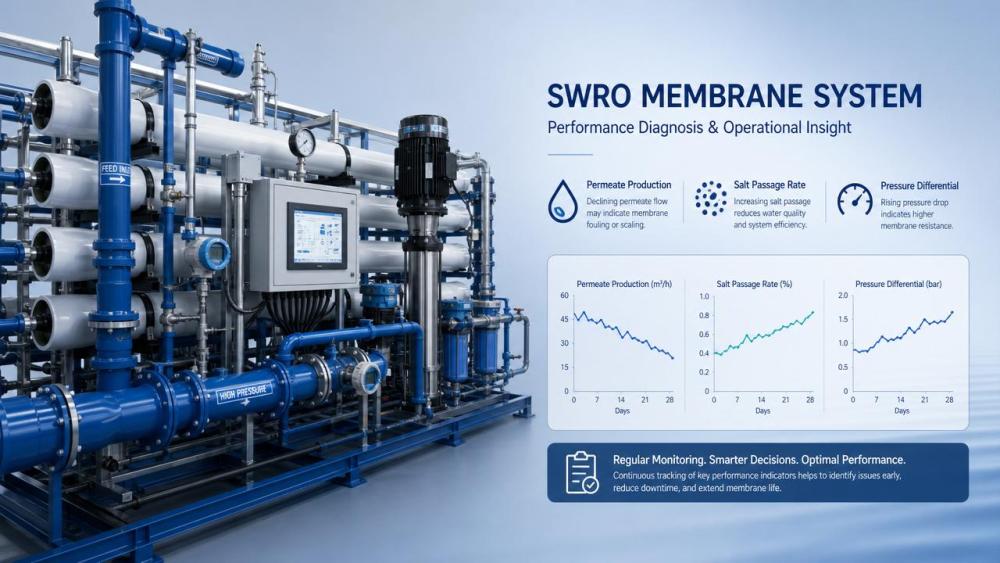
SWRO Membranes now operate under tighter technical and commercial expectations. Plants are asked to deliver stable output, lower energy use, and stronger ESG reporting at the same time.
This shift changes how efficiency loss is interpreted. What once looked like normal aging may now be treated as a warning sign of hidden pretreatment failure or process drift.
In many coastal regions, feedwater variability has also increased. Seasonal algae, storm-driven turbidity, higher organics, and temperature swings make SWRO Membranes more sensitive to upstream inconsistency.
As a result, membrane troubleshooting is becoming a strategic operations issue, not just a maintenance task.
The first signals usually appear before severe SWRO Membranes failure
Loss of efficiency in SWRO Membranes often develops gradually. Early detection depends on trend analysis rather than isolated daily readings.
Watch for these combined indicators
- Permeate flow declines at constant feed pressure.
- Normalized permeate flow falls faster than expected.
- Salt rejection decreases or permeate conductivity rises.
- Differential pressure across stages increases.
- Specific energy consumption trends upward.
- Cleaning frequency becomes shorter than baseline.
A single indicator can mislead. The real value comes from comparing flux, pressure, rejection, and temperature-corrected performance together.
What usually drives declining SWRO Membranes efficiency
Most efficiency losses in SWRO Membranes come from a limited group of causes. The challenge is separating symptoms from origin points.
The practical lesson is simple. Do not blame SWRO Membranes first when upstream quality control may be the real trigger.
What to inspect first when SWRO Membranes output starts falling
A disciplined inspection sequence reduces downtime and avoids wrong cleaning choices. Start with data quality, then move toward feedwater and hardware.
1. Confirm instrumentation reliability
Check pressure transmitters, conductivity meters, flowmeters, and temperature sensors. Bad data can make healthy SWRO Membranes appear damaged.
2. Review normalized performance trends
Compare current values with startup baseline and post-cleaning baseline. Normalization removes distortion from temperature and salinity changes.
3. Examine feedwater quality shifts
Look at SDI, turbidity, TOC, chlorophyll trends, iron, manganese, and microbial indicators. Small changes upstream can strongly affect SWRO Membranes later.
4. Verify pretreatment stability
Inspect media filters, UF systems, cartridge filters, coagulant dose, and backwash quality. Pretreatment instability is a leading cause of recurring membrane underperformance.
5. Check chemical dosing and residuals
Review antiscalant selection, dechlorination effectiveness, acid control, and pH trends. Even brief dosing interruptions can damage SWRO Membranes or accelerate scale formation.
6. Inspect stage-by-stage pressure behavior
A localized pressure drop increase may indicate front-end fouling. Rear-stage issues may point more toward scaling or concentration polarization.
How changing operating conditions affect different business links
Declining SWRO Membranes efficiency affects more than water output. It changes plant economics, maintenance planning, compliance confidence, and even project bankability.
For operations, the direct impact is lower productivity and higher energy demand. For engineering teams, recurring loss of efficiency signals weak design margins or pretreatment mismatch.
For asset owners, shorter membrane life raises lifecycle cost and disrupts performance guarantees. In water-stressed regions, unstable SWRO Membranes performance can also affect supply resilience.
- Higher OPEX from pumping energy and chemical cleaning.
- Greater replacement cost from premature membrane aging.
- More downtime from unscheduled troubleshooting.
- Harder ESG reporting when energy intensity rises.
The most important checkpoints deserve regular attention
Instead of reacting only after severe decline, focus on recurring checkpoints that protect SWRO Membranes before irreversible damage develops.
- Track normalized flow, rejection, and differential pressure weekly.
- Correlate intake events with membrane trend deviations.
- Audit pretreatment barrier performance after storms or blooms.
- Validate cartridge filter condition and replacement discipline.
- Review CIP timing before fouling becomes compacted.
- Confirm no oxidant leakage reaches the RO train.
- Inspect recovery settings against current feed chemistry.
These checkpoints improve decision quality because they connect membrane symptoms with actual process causes.
Cleaning results often reveal whether SWRO Membranes are fouled or damaged
Cleaning performance is a powerful diagnostic tool. If SWRO Membranes recover strongly after CIP, fouling or scaling is more likely than permanent damage.
If flow improves but salt rejection does not, membrane oxidation or physical damage may be involved. If pressure drop stays high, deposits may be compacted or cleaning chemistry mismatched.
A better response is to build diagnosis into routine SWRO Membranes management
The most effective response is not a one-time fix. It is a repeatable decision framework that links data, chemistry, pretreatment, and asset inspection.
Use a simple sequence: verify instruments, normalize trends, review feedwater events, inspect pretreatment, test dosing reliability, analyze cleaning recovery, then inspect membrane hardware if needed.
This approach protects SWRO Membranes, lowers avoidable energy use, and improves confidence in plant performance forecasting.
If SWRO Membranes are losing efficiency, begin with evidence, not assumptions. A faster diagnosis today often prevents a much costlier desalination problem tomorrow.
Recommended News
 Thermal Sludge Treatment Options: Drying, Pyrolysis, and Incineration ComparedJun 03, 2026Thermal Sludge Treatment compared: discover how drying, pyrolysis, and incineration impact cost, emissions, energy recovery, and smarter sludge decisions.
 Environmental Engineering for ZLD Projects: Site Data, Permits, and Design RisksJun 03, 2026Environmental Engineering for ZLD projects: learn how site data, permits, brine chemistry, and design risks shape compliant, reliable, cost-effective water recovery.
 Zero Waste Water vs ZLD: Process Choices for Industrial Effluent ReuseJun 03, 2026Zero Waste Water or ZLD? Compare process routes, energy, brine handling, compliance risks, and reuse strategies to choose the right industrial effluent solution.
 Sustainable Waste Management Strategies for Plants With Mixed Waste StreamsJun 03, 2026Sustainable Waste Management strategies for mixed waste plants—cut disposal risk, improve ESG readiness, recover resources, and build a smarter circular operating model.